The wind dies down, the power's still out, and by the next afternoon there's a truck with out-of-state plates parked on your street. A guy in a company polo is already knocking on doors, clipboard in hand, offering a "free inspection" and a roof that can be signed, sealed, and started before the week is out. That scene repeats after every major storm in Florida, and it's the starting point for most of the roofing scams we get called in to untangle afterward. Not every crew that shows up uninvited is running a con — but knowing the difference before you sign anything is what keeps a bad storm from turning into a worse year.
Key takeaways:
-
Storm chaser roofers travel from disaster to disaster with no local accountability — the risk isn't that all of them are crooks, it's that you can't tell which ones are until it's too late.
-
Florida's high hurricane frequency and steep insurance premiums make it a top target for door-to-door roofing scams.
-
Unlicensed contracting is a felony in Florida during a declared state of emergency — not just a misdemeanor.
-
Florida gives homeowners an additional 10-day right to cancel certain roof repair or replacement contracts signed within 180 days of a declared state of emergency.
-
Federal law gives you a 3-day right to cancel most contracts signed at your door.
What Is a Storm Chaser Roofer, Exactly?
A storm chaser is a roofing crew that follows severe weather from state to state instead of working out of a permanent local base. They typically arrive within days of a hurricane, canvass the hardest-hit neighborhoods door to door, and move on within a few weeks, once the easy work dries up.
Here's the honest part: not every out-of-town crew is running a scam. Some legitimate contractors genuinely travel to help meet demand after a major disaster. The problem is you can't tell the difference standing on your porch, and if the work fails in eighteen months, a crew with no local address and no reason to come back isn't the one who answers the phone. That's the real risk with storm chaser roofers — not that all of them are dishonest, but that you have no way to hold the dishonest ones accountable once they've left the state.
Florida Storm Chasers: Why This State Is a Top Target
Florida storm chasers aren't a coincidence — the state is close to ideal conditions for this kind of activity. Florida sees more hurricanes and tropical storms make landfall than any other state, which means a bigger, more predictable wave of roof damage every season. Layer on top of that some of the highest homeowners insurance premiums in the country, plus separate hurricane deductibles that can run 2 to 10 percent of a home's insured value, and you get exactly the kind of financial pressure that scam operators are built to exploit.
The scale of the problem shows up in enforcement numbers, too. After Hurricanes Ian and Nicole, DBPR was working more than 200 cases by early 2023; by early 2024, it was working more than 1,200 unlicensed-activity cases tied to Ian, Nicole and Idalia.
We're not the only local roofing company in this state, and we're not going to pretend we are. But we'll be here in three years when an out-of-state truck won't be — and that's the entire reason a license and a local track record matter more than whoever quotes the lowest number on day one.
Door-to-Door Roofing Scams: The Patterns That Repeat Every Storm Season
Most door-to-door roofing scams in Florida follow one of a handful of recognizable patterns. None of them require special expertise to catch — they just require slowing down.
|
Pattern |
What it looks like |
Why it's dangerous |
|
Same-day pressure |
"Sign today or the price goes up." "Materials are only reserved for this street today." |
Urgency is the entire sales tool — it exists to stop you from checking anything. |
|
Deductible waiver offer |
"We'll cover your deductible if you sign with us." |
This isn't a discount. The contractor usually recoups it by inflating the claim — a form of insurance fraud that can expose the homeowner too. |
|
AOB or "authorization" paperwork |
Being asked to sign over your insurance benefits, or to sign a repair authorization with no itemized estimate. |
For policies issued on or after January 1, 2023, Florida law makes AOBs void. A contractor who still pushes one either doesn't know the law or is counting on you not knowing it. |
|
Cash deposit, then silence |
A large upfront deposit in cash, on a handshake or a vague one-page contract. |
This is the pattern behind most "they took my money and disappeared" complaints every hurricane season. |
The Assignment of Benefits pattern deserves a closer look, because it's the one that looks the most like normal paperwork. Florida's Department of Financial Services is direct about what your actual first responsibility is after a loss: to mitigate further damage and notify your insurer — not to sign your claim rights over to whoever knocked first. Florida effectively ended AOBs in December 2022: any attempt to assign post-loss benefits under a residential policy issued on or after January 1, 2023 is void. If your policy is older, confirm its issue date with your insurer. Florida law also bars contractors from handing you a repair authorization without a good-faith, itemized estimate. If a contractor pushes an AOB or vague authorization paperwork, that's a reason to slow down, not sign faster.
Storm Chaser Roofers and the License Problem
Every roofing contractor working in Florida is legally required to hold a state contractor license — a Certified Roofing Contractor (CCC) or Registered Roofing Contractor license. There's no informal, "good enough" version of this requirement.
What most homeowners don't realize is how much higher the stakes get during an actual disaster. Under Florida Statute § 489.127, unlicensed contracting is normally a first-degree misdemeanor. But the statute escalates this to a third-degree felony when the violation occurs during a state of emergency declared by the Governor — exactly the window when storm chasers are most active. Florida's own licensing agency confirms the same thing in its consumer hurricane guidance: during a declared state of emergency, the penalty for unlicensed activity is elevated from a misdemeanor to a third-degree felony. In other words, the crew knocking on your door in the days after a hurricane is operating under the highest legal stakes of the entire year if they're unlicensed — whether they mention that or not.
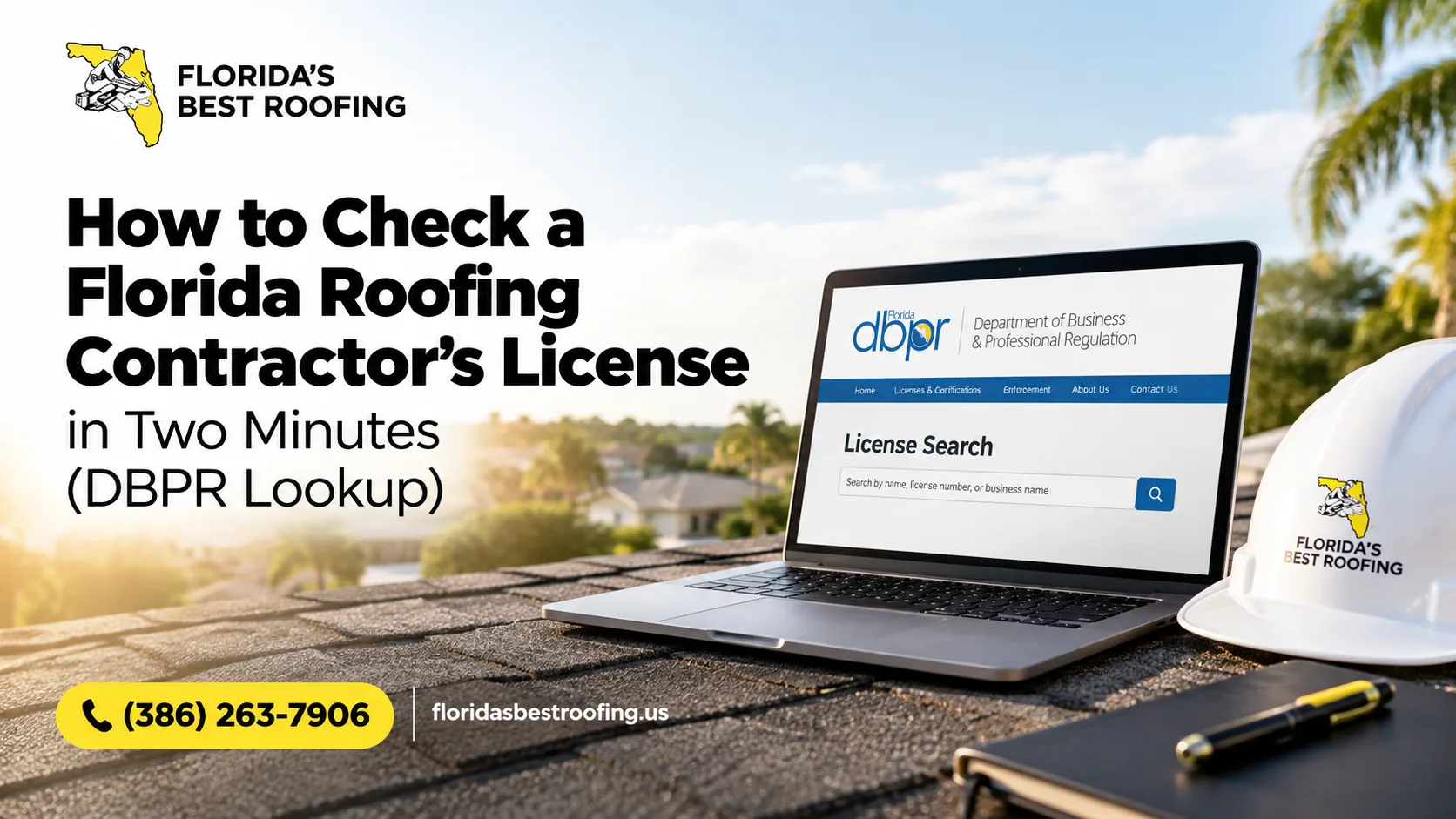
Checking a license takes less time than the sales pitch. Search the contractor's license number through Florida's DBPR license search, confirm the status reads "Current, Active," and check that the name on the license matches the person or company standing in front of you. If any of that doesn't line up, that's a hard stop, not a detail to sort out later.
Your Right to Cancel: Florida's 10-Day Rule and the Federal 3-Day Rule
Even if you've already signed something you regret, you may still have a way out.
Florida adds a stronger, roofing-specific right. If you sign a roof repair or replacement contract within 180 days of a declared state of emergency and your home is in the affected area, you can cancel without penalty within 10 days, or before the official start date, whichever comes first. That start date can arrive fast: it's triggered when materials go on, a permit is issued, or a temporary repair is made. Send your cancellation by certified mail, return receipt requested.
Separately, under the Federal Trade Commission's Cooling-Off Rule, contracts signed at your home or somewhere other than the seller's permanent place of business can generally be cancelled within three business days, no reason required. The seller is legally required to hand you two copies of a cancellation form at the time of signing.
If the crew that just signed you up never gave you the required cancellation notice, that's a reason to slow down and check your rights before work begins.
Red Flags to Watch For at the Door
A short list, because you shouldn't need more than this to make a fast, safe decision:
-
No local address, and out-of-state plates or lettering on the truck
-
An offer to "handle" your insurance claim. In Florida, only a licensed public adjuster can advise you on coverage or adjust a claim on your behalf
-
Reluctance or evasiveness when you ask to see a license number
-
Insistence on full payment, in cash, before any work begins
-
"Today only" pricing or pressure to sign before you've had time to think
What a Legitimate Local Roofer Does Differently
A roofer who plans to still be doing business here next year behaves differently, and it shows in small, specific ways:
-
They operate under their own name, with a verifiable local address and a track record you can actually check.
-
They'll inspect the roof and give you a straight answer, without requiring a signature the same day.
-
They'll document the damage and give you an itemized estimate you can share with your insurer, without asking you to sign over your claim.
-
They give you a written scope of work — and they'll tell you honestly when a repair is the right call instead of a full replacement, even when the repair is the smaller job for them.
Roofers first, salespeople never. That's not a slogan on a truck — it's the difference between a company that wants your signature today and one that wants your roof to actually hold up.
What to Do If You Already Signed Something
Don't panic, and don't assume it's too late. First, check whether Florida's 10-day cancellation right applies. If you signed a roof repair or replacement contract within 180 days of a declared state of emergency and your home is in the affected area, you may be able to cancel without penalty within 10 days, or before the official start date, whichever comes first. Send your cancellation by certified mail, return receipt requested.
If that Florida window doesn't apply, check the FTC's 3-day cancellation window. If it is still open, follow the cancellation instructions on the form you were given, in writing, before that window closes.
If something already feels wrong — the crew has gone quiet, work hasn't started, or you suspect the license was fake — file a complaint with Florida's DBPR through its online complaint portal, and involve the Florida Attorney General's Office if fraud is suspected. Before paying any remaining balance, get a second opinion from a licensed local contractor. It costs nothing to have someone else look at the contract and the roof before more money changes hands.
FAQ
What is a storm chaser roofer?
A contractor or crew that travels from state to state following severe weather, canvassing storm-damaged neighborhoods door to door rather than working from a permanent local base. Not all are scams, but their lack of local accountability is the core risk.
How do I know if a roofing contractor is licensed in Florida?
Search the contractor's name or license number through Florida's DBPR license lookup at myfloridalicense.com. Confirm the status is "Current, Active" and that the licensed individual's name matches who's standing in front of you.
Can a roofing contractor waive my insurance deductible?
No. Florida law prohibits contractors from offering to waive your deductible in exchange for a roof inspection or an insurance claim, and knowingly waiving or rebating a deductible is insurance fraud — a third-degree felony.
Do I have the right to cancel a roofing contract after signing?
Often yes. Under the FTC's Cooling-Off Rule, contracts signed at your home can generally be cancelled within three business days, and the seller is required to provide a cancellation form at signing.
What happens if I hire an unlicensed roofer in Florida during a hurricane?
You won't face criminal charges, but you lose important protections. DBPR can't recover your money for you, and Florida's Homeowners' Construction Recovery Fund doesn't cover work by unlicensed contractors. For the contractor, working unlicensed during a declared state of emergency is a third-degree felony.