You are standing in the yard of a house you want to buy. The listing says "roof in good condition." Or an insurance letter just landed in your mailbox, and it asks one simple question: how old is the roof?
Here is the honest answer. No single record shows it. But in Florida you can almost always build the proof, because roof replacements usually leave a paper trail. So, how can I find out how old my roof is? Start with the city permit, then work down to the roof itself. This guide covers five ways, strongest first.
We are roofers, not insurance agents. We will tell you what we can show you, and where our word stops.
In short
-
Best source: the re-roof permit from your city or county.
-
Backups: your closing file, old inspection reports, the previous owner, and a roofer's inspection.
-
Be realistic: nobody can date a roof to the exact year by looking at it. A roofer can give you an age range and the remaining life.
-
For insurance: a document beats a guess every time.
Why Roof Age Matters So Much in Florida
Florida is hard on roofs. Strong sun bakes shingles. Humidity feeds algae and moisture problems. Summer storms and hurricane winds test every nail. The same roof that lasts 25 years in a mild climate may need attention much sooner here.
That is why age drives so many decisions: what you pay for insurance, whether a carrier will write or renew a policy, and how much room you have in a home-buying budget. These are general ranges, and your roof may land outside them:
|
Roofing material |
Typical lifespan in Florida |
|
Asphalt shingles |
About 15–25 years |
|
Concrete or clay tile |
About 30–50 years (underlayment often wears out sooner) |
|
Metal |
About 40–70 years |
|
Flat or modified bitumen |
About 10–20 years |
So a roof that is 12 years old is not a problem. A roof of unknown age is. That is the gap this guide helps you close.
How Can I Find Out How Old My Roof Is? Five Ways, Strongest First
Start with the paperwork. Climb a ladder last.
|
Way |
Where to look |
How strong as proof |
|
Permit records |
City or county building department |
Strongest |
|
Your paperwork |
Closing file, inspection reports, wind mitigation form |
Strong if dated (a wind mitigation form is only a lead) |
|
People who know |
Previous owner, original roofer, HOA |
Useful, needs a paper backup |
|
The roof itself |
Inspection by a roofer |
An estimate, not a date |
|
Aerial photos |
Historical aerial imagery |
Shows a change, not a date |
Way 1. Check the permit record
In Florida, replacing a roof normally requires a permit. The city or county keeps a record of it. That makes it the closest thing your roof has to a birth certificate.
Most building departments let anyone search by address online. In Palm Coast, for example, a re-roof shows up with a type like "RF – REROOF," an issue date, the owner, and the contractor. Search your own address on your city or county permit portal. Can't find it online? Call the building department. They can usually pull it for you.
Look for:
-
A permit type that says re-roof or roof replacement
-
The issue date
-
A final inspection, which means the work passed
-
The contractor's name and license number
Three honest limits. The permit date is not always the day the work finished. Older records can be incomplete or missing. And a roof put on without a permit leaves no record at all. If that happens, move on to Way 2.
Way 2. Dig through your paperwork
If you own the home, the answer may already be sitting in a folder. Check:
-
Closing documents and seller disclosures
-
The home inspection report from when you bought
-
Any past 4-point or roof inspection
-
Contractor invoices and manufacturer warranty papers
-
Old insurance policies and renewal notices
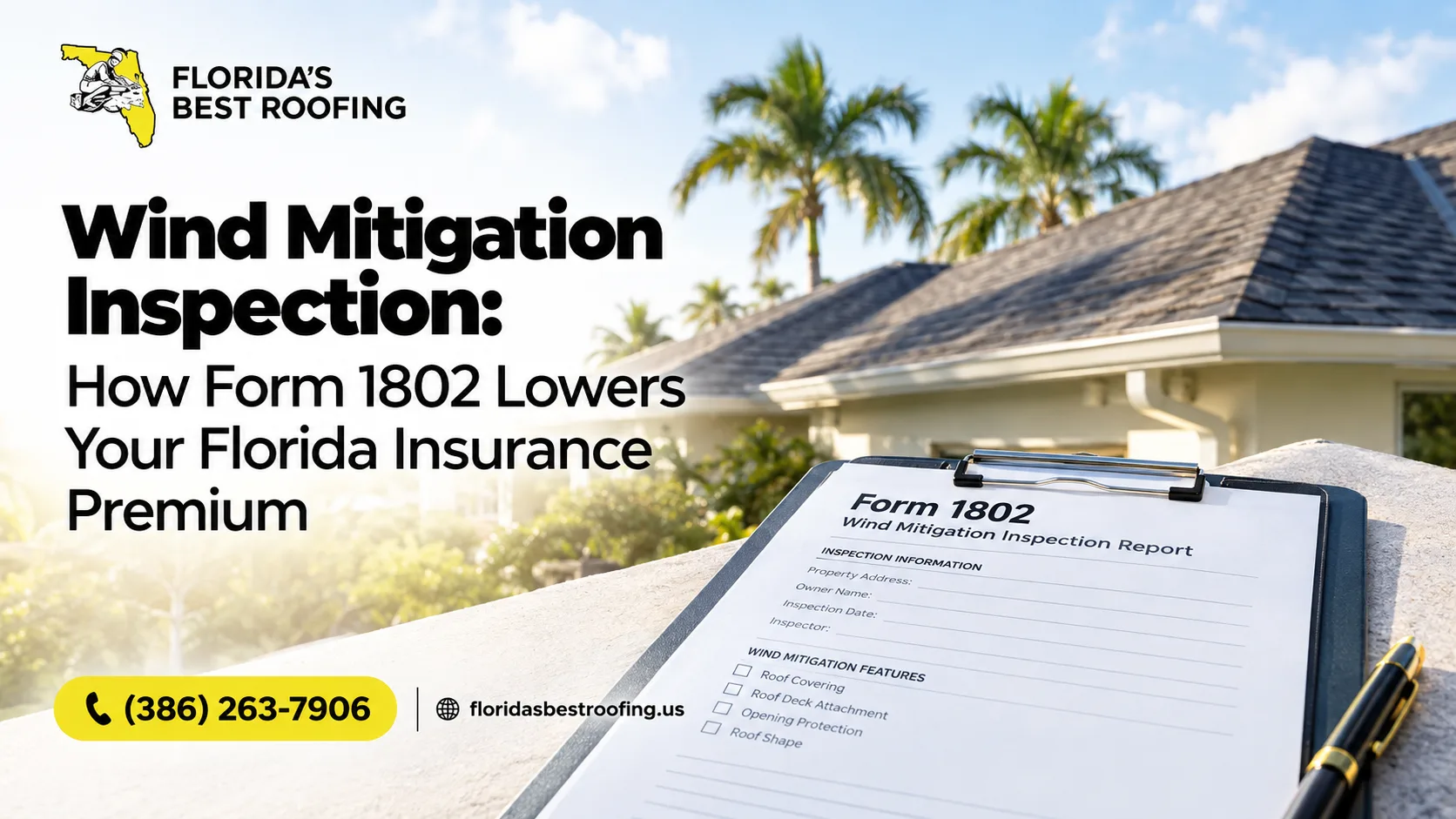
One useful find is the wind mitigation form, officially the Uniform Mitigation Verification Inspection Form OIR-B1-1802. In the Roof Covering section, the inspector records a permit application date, a product approval number, or the year of installation or replacement. That can point you to a date.
But treat it as a lead, not a verdict. Citizens' own guide to the current form says it verifies wind features only and is not acceptable proof of roof condition or replacement. Confirm the date with a permit or an invoice.
Also watch the "roof age" line on seller forms. Sellers often fill it in from memory.
Way 3. Ask the people who know
People remember things records miss.
-
The previous owner. Ask when the roof was replaced and who did it.
-
The original roofer. A licensed contractor can often confirm the job from their own files.
-
Your HOA or neighbors. Homes in the same development often have roofs of similar age. Often, not always. Treat it as a clue.
Whatever you hear, get it in writing or find a record that matches it. A friendly word from a neighbor won't satisfy an insurer.
How to Tell How Old Your Roof Is From the Roof Itself
When the paper trail goes cold, the roof still talks. Here is how to tell how old your roof is when there are no records.
Way 4. Have a roofer read it
A good roofer looks at wear patterns, not just the surface. On a typical inspection we check:
-
Granule loss. Asphalt shingles are coated with tiny mineral granules that shield the asphalt from the sun. When they wash off, the bare asphalt underneath ages faster. Look in your gutters and at downspout outlets for loose granules.
-
Curling, cupping, and cracking in the shingles
-
Raised or backed-out nails
-
Flashing around chimneys, vents, and walls
-
Layers. Is it one roof or two stacked?
-
The decking from the attic. Stains, soft spots, or daylight tell their own story.
It also helps to know what different ages tend to look like. Wear depends on the slope, too. South- and west-facing slopes usually age faster in the Florida sun.
|
Roof condition |
What it often means |
|
Even color, tight edges, few loose granules |
Younger roof, likely under 10 years |
|
Fading, light granule loss, minor lifted tabs |
Mid-life, roughly 10–15 years |
|
Curling, bare patches, brittle shingles, repeated repairs |
Late life, often 15+ years for shingles |
This table is a guide, not a measurement. It is the kind of thing a roofer weighs together with the materials, the slope, and the maintenance history.
Here is the plain truth: nobody can read a roof down to the exact year. What you get is an age range and the remaining useful life. That is still valuable, and many insurers ask for exactly that.
We do this as part of our roof repair services, with a free inspection, drone photos, and a photo report. If the roof still has years left, we will say so, and suggest a repair instead of a replacement.
Way 5. Compare aerial photos
Historical aerial images can show when a roof changed color or shape. If a roof looks dark and uniform in a 2015 image and patchy in a 2008 image, a replacement likely happened in between.
This is a hint, not a date. Use it only to support the other ways.
Roof Age Verification: What Buyers and Insurers Will Accept
Roof age verification is where many Florida buyers get stuck. Insurers don't want your opinion about the roof. They want proof.
How insurers count age. Rules differ by carrier. Florida's homeowners' insurance law, section 627.7011, deals with roof age and inspections. In general, age runs from the last time the roof was replaced, and a partial replacement is treated differently from a full one. Ask your agent exactly how your carrier counts it.
What is usually accepted:
-
A closed permit with a final inspection
-
A paid contractor invoice
-
A letter from a licensed roofing contractor or inspector that states age, condition, and remaining life
Citizens, for example, publishes its forms and requirements on its inspections page. Always check the current rules with your own insurer.
What is usually not accepted: "About 10 years old," said by the seller.
No documents? Order a roof inspection that states the estimated age and remaining useful life.
Buying a House? What to Ask Before You Close
An old roof is not a dealbreaker. A surprise is.
Before you close:
-
Ask the seller for the re-roof permit, or pull it yourself by address.
-
Ask your insurance agent what roof age and documents the carrier wants.
-
Book a roof inspection separate from the general home inspection.
If the roof turns out to be older, you have options: negotiate the price, ask for a credit, or plan the work. We explain how to weigh that in Should You Buy a House With an Old Roof?
What If You Still Can't Find the Date?
It happens, especially with older homes. Here is the plan:
-
Get a roof inspection with a written estimate of age and remaining life.
-
Take that report to your insurance agent and ask if the carrier accepts it.
-
Decide with real numbers: repair, monitor, or replace.
That is how to check roof age when the records fail. And if the roof has life left, a repair is often enough. We will tell you that.
Need a second pair of eyes?
If you want a second pair of eyes, call us. We will look at the roof and tell you what we see, even if the answer is "you don't need us yet." Reach us through our contact page.
FAQ
How can I find out how old my roof is for free?
Start with your city or county permit search, then look through your closing file and old inspection reports. Both cost nothing.
Can a roofer tell the exact age of my roof?
No. A roofer can give you an age range and the remaining useful life. For an exact year, you need a permit or an invoice.
Does the property appraiser show roof age?
Sometimes, but not reliably. It usually lists the year the house was built, which isn't the roof's age. Don't use it as proof.
Does a permit date always match the install date?
Not always. The permit date shows when the work was approved. The job may have finished weeks later. The final inspection date is a better marker.
How long are permit records kept?
That depends on your city or county. Call your building department and ask.
What if the seller does not know the age?
Pull the permit yourself, then order a roof inspection before you close. Don't rely on a guess.