A storm can pass in a matter of hours, but the damage it leaves behind can shape your home's safety and value for years. For Florida homeowners, this isn't a hypothetical risk - it's an annual reality. Hurricanes, tropical storms, hail, and straight-line winds put constant stress on roofing systems, and a handful of missing shingles seen from the driveway can be hiding moisture intrusion, compromised underlayment, or weakened decking that isn't visible until it's already expensive.
The question almost every homeowner asks after the wind dies down is the same one: do I need a repair, or does the whole roof need to come off? The roof repair vs roof replacement decision is rarely a simple call. Move too slowly and water damage spreads into insulation, drywall, and framing. Replace a roof that didn't need it, and you've spent thousands of dollars you didn't have to spend. The right answer depends on the extent of the damage, the roof's age and condition, what your insurance policy actually covers, and - often overlooked - the true long-term cost of patch after patch versus one durable fix.
This guide walks through how to evaluate storm damage, when repair genuinely makes sense, when replacement is the smarter investment, and how insurance and Florida's building codes factor into the decision.
First Steps After Storm Damage
What you do in the first 24 to 48 hours after a storm often determines whether roof damage stays manageable or turns into a much larger problem. Even a home that looks fine from the street can have wind uplift, hail bruising, or water intrusion happening out of sight.
Stay off the roof. It's tempting to climb up and see for yourself, but a storm-damaged roof is genuinely dangerous - wet surfaces, loose shingles, and weakened decking can give way without warning. Inspect from the ground or a safe distance instead. The Ready.gov after-a-disaster guidance echoes this: wait until conditions are stable before doing anything beyond a visual walk-around.
Document everything you can see safely. Photos and video of missing or lifted shingles, damaged flashing, sagging gutters, and any interior stains or active drips will matter later, both for your contractor's assessment and for your insurance claim.
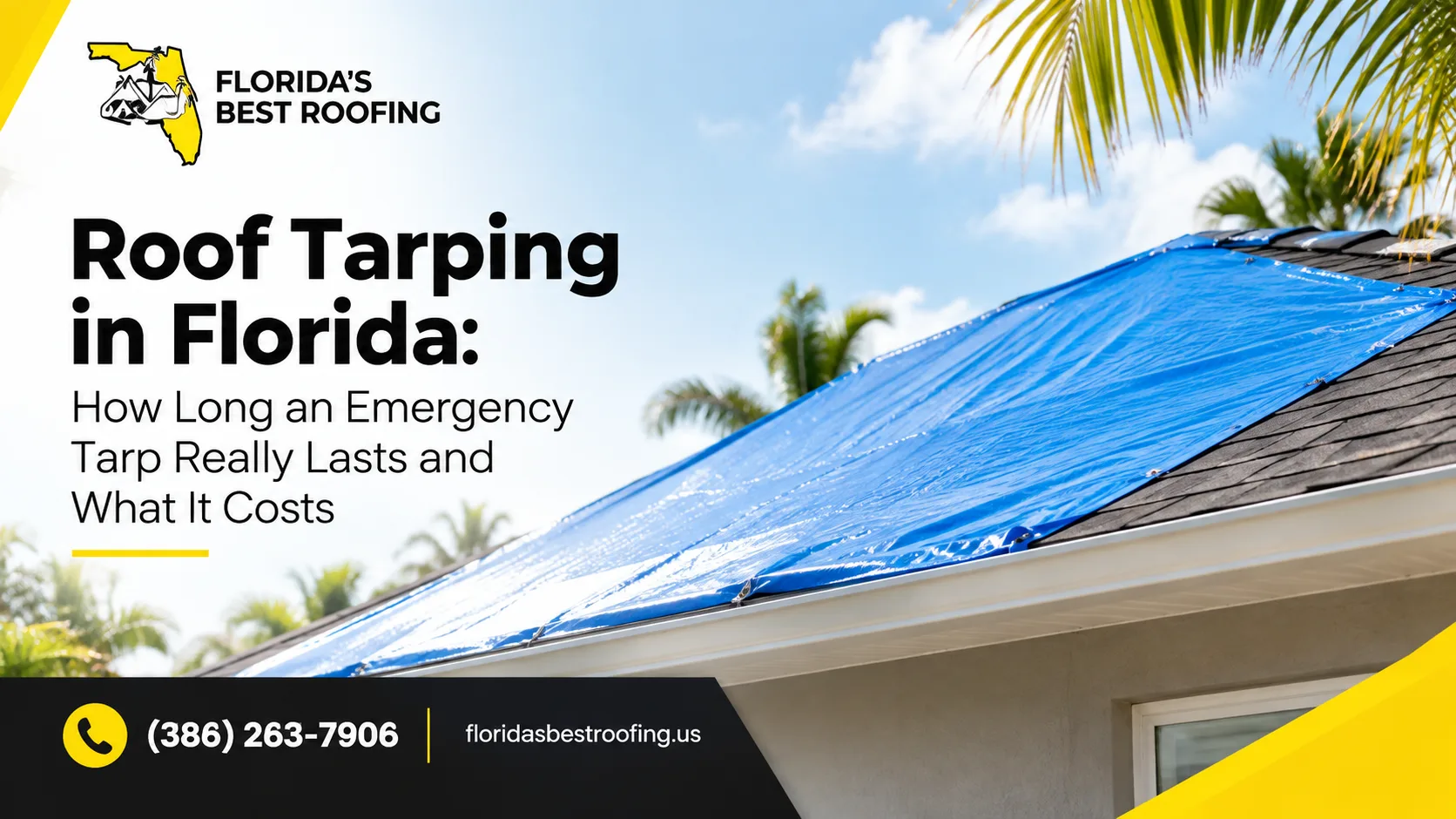
Stop water from spreading indoors. If water is already coming through, move furniture and valuables clear of the leak, set out buckets, and get airflow into damp rooms. If the roof has an open section, a licensed contractor can install an emergency tarp - it's not a fix, but it buys time and limits secondary damage like mold and swollen drywall.
Call a roofer before you call it fine. One of the most common - and costly - mistakes is waiting a few weeks to have a professional look at the roof. Leaks can travel sideways under roofing material and stay invisible until insulation or wood has already started to deteriorate. A licensed contractor can run an emergency inspection and tell you, honestly, whether targeted damaged roof repair will hold or whether you're looking at a full roof replacement after storm damage.
Start your insurance paper trail early. Insurers generally expect homeowners to take reasonable steps to prevent additional damage, so keep every inspection report, mitigation invoice, and photo. The NOAA hurricane preparedness resources and FEMA's disaster recovery guidance are both useful for understanding what documentation typically matters and how the broader recovery process works.
When Emergency Repairs Are Genuinely Enough
Not every storm-damaged roof needs to come off. After severe weather, plenty of homeowners assume replacement is the "safe" default, but a proper inspection often shows the damage is contained enough that timely damaged roof repair restores full performance. Here's where that's usually true.
Missing shingles in a limited area. Florida wind can peel shingles off a single slope without touching the rest of the roof. If the surrounding materials and underlayment are intact, a contractor can typically replace the missing shingles, reseal the surrounding tabs, and reinforce that section against the next storm - all without a full tear-off.
A leak with no structural involvement. A leak doesn't automatically mean the roof has failed. Wind-driven rain can find its way in through lifted shingles or a small gap in flashing while leaving the rest of the roof structurally sound. Caught early, this usually means sealing the affected area, replacing the compromised underlayment, and drying out the space - problem solved.
Flashing and vent damage. Flashing around chimneys, skylights, valleys, and roof penetrations is one of the most common failure points in a storm, and also one of the easiest to repair. Re-securing or replacing flashing and vent boots typically resolves the leak without touching the rest of the roofing system.
Localized debris impact. Not every fallen branch punches through to the deck. If an inspection confirms the impact area is contained and the decking underneath is sound, a focused repair - rather than a full replacement - is often the right call.
The through-line in all of these cases is the same: a professional inspection, not a guess from the ground, is what separates a roof that needs a patch from one that needs to come off. Making the right call in the roof repair vs roof replacement decision starts with accurate inspection, not assumptions - paying for a full replacement before that inspection happens is money spent on a guess.
When Replacement Is Actually the Better Investment
On the other side of that same coin, there are situations where repair only delays a more expensive problem, and a full storm roof replacement ends up being the more cost-effective path over time.
Shingle loss spread across multiple slopes. When damage isn't confined to one section but shows up across the roof, it's usually a sign the roofing system as a whole has lost its ability to seal against water. Even without visible leaks yet, that kind of broad exposure tends to get worse, not better.
Leaks in more than one room. One leak can be a repair. Water stains showing up in different parts of the house at the same time usually points to a systemic issue rather than a single failure point, since water travels under the roofing material before it ever reaches the ceiling.
Damage to the roof deck itself. Shingles are only the top layer. If a storm has compromised the plywood or OSB decking underneath, cosmetic repairs won't restore structural performance - sagging, soft spots underfoot, or ceiling cracking are signs the deck itself needs attention, and at that point replacement is usually the safer path.
A roof that was already near the end of its life. This is the factor people forget to weigh. A 20-year-old roof that "could" technically be patched will keep generating problems as the rest of the material ages around the repair. According to the Insurance Information Institute, roof age is one of the first things adjusters and contractors look at when weighing repair against replacement.
A pattern of repeat repairs. If this is the third or fourth storm-related service call on the same roof, it's worth adding up what you've spent. Multiple visits, temporary mitigation, and interior restoration can quietly approach - or exceed - the cost of a new roof, while still leaving you with an aging system that will need attention again next season. In these situations, delaying storm roof replacement often increases total ownership costs rather than reducing them.
Roof Repair vs. Replacement: Comparing the Real Costs
The instinct after a storm is to go with whatever costs less right now, and for genuinely localized damage, that instinct is correct - emergency repair is often the smarter, cheaper option. But the real roof repair vs roof replacement comparison gets more complicated once you factor in what happens after the invoice is paid.
|
Factor |
Emergency Repair |
Full Replacement |
|
Upfront cost |
Lower |
Higher |
|
Long-term value |
Moderate |
High |
|
Lifespan extension |
Limited |
Full reset |
|
Insurance potential |
Varies by policy |
Often higher when structural damage is documented |
|
Storm resilience going forward |
Moderate |
Strong |
A few things tend to shift that math in ways homeowners don't expect. First, hidden damage changes the equation - trapped moisture, saturated insulation, and weakened fasteners can keep costing money long after the visible repair is finished, because none of that shows up on a surface-level inspection. Second, repeated repairs add up faster than people assume; several smaller service calls over a year or two can quietly approach the price of replacement while leaving an aging roof in place. And third, warranty coverage matters more than it gets credit for - a full replacement typically comes with broader workmanship and material warranties than a targeted repair, which adds real value heading into the next hurricane season.
The honest version of this comparison isn't "cheaper vs. more expensive." It's "lower risk now vs. lower risk later" - and the right answer depends on which one your specific roof actually needs.
Will Insurance Cover Roof Replacement After a Storm?
This is usually the second question homeowners ask, right after "repair or replace." The honest answer is: it depends - on what caused the damage, your roof's age and condition, your specific policy terms, your deductible, and how quickly the damage was documented. When storm damage is severe enough, insurance may contribute to storm roof replacement, though coverage varies by carrier.
Most homeowner policies cover sudden, storm-related damage from wind, hail, or falling debris, but they generally exclude wear and tear or deferred maintenance. That distinction matters a lot in claims decisions, and it's worth knowing before you assume a payout is coming.
Wind damage and flood damage are treated very differently, which trips up a lot of Florida homeowners. If wind removes shingles and rain gets in through the opening, that's typically a homeowner's policy matter. If storm surge enters at ground level, that's flood damage, and it's almost always excluded from a standard policy - you'd need separate flood coverage through a program like the National Flood Insurance Program. Reading your policy's cause-of-loss language before assuming coverage can save a lot of frustration later.
Documentation genuinely moves the needle. Photos taken right after the storm, inspection reports, mitigation invoices, and a clear timeline with your insurer all help establish that the damage was sudden and storm-related rather than gradual deterioration. Adjusters are specifically evaluating whether the damage was sudden, tied to a covered event, and severe enough to justify replacement rather than a spot repair - the Florida Office of Insurance Regulation publishes consumer guidance on what to expect during this process.
Timing matters more than people think. The longer water intrusion continues after a storm, the harder it becomes to separate original storm damage from damage that developed afterward - which can complicate a claim. A fast inspection preserves evidence while it's still clearly attributable to the storm.
A good contractor doesn't just estimate repair costs - they help document hidden damage, produce the photo-backed reports adjusters actually want to see, and lay out a clear repair-versus-replacement comparison you can bring into the claims conversation. That doesn't guarantee approval, but it puts you in a much stronger position than a verbal opinion and a handshake.
Why Florida Roofs Play by Different Rules
A roofing system that holds up fine in a mild climate can behave very differently under hurricane-force wind, sustained humidity, and repeated storm cycles year after year. That's the backdrop for a few things that are specific to evaluating roofs in Florida.
Cumulative exposure matters, even without a direct hit. A storm doesn't need to make landfall on your property to stress your roof. Wind uplift, wind-driven rain, and debris impact from storms that pass nearby still add up over time, which is one reason a roof can look fine and still be quietly losing integrity.
Building codes have gotten stricter, for good reason. The Florida Building Code sets location-based wind design standards and approved roofing systems specifically to improve hurricane performance. One of the most important rules for Florida homeowners is the state's "25% rule." For roofs permitted before March 1, 2009, if more than 25% of the existing roof section requires repair or replacement within a 12-month period, Florida code generally requires the entire roof covering to be replaced so it complies with current code requirements. That isn't simply a cost consideration - it can be a legal requirement.
For newer roofs, however, the rules changed with Florida's SB 4-D (2022). If the existing roof complies with the 2007 Florida Building Code or a later edition, replacing more than 25% of the roof no longer automatically triggers a full reroof. In many cases, only the repaired portion must be brought up to the current code. That's why the same amount of storm damage can lead to very different repair options depending on when the roof was originally permitted.
Humidity keeps working on the roof after the storm ends. Trapped moisture and small openings can continue to affect insulation, underlayment, and decking well after the weather clears, which is why prompt, damaged roof repair - not a wait-and-see approach - tends to catch problems while they're still small.
Age hits harder here. A roof that's spent years under Florida sun, humidity cycles, and repeated storm stress often has less margin left than the same roof would in a milder climate. That's a real factor in whether repair extends the roof's useful life meaningfully, or whether storm roof replacement is the more reliable investment before the next hurricane season.
How a Professional Inspection Prevents Expensive Mistakes
Visible damage is only ever part of the picture, which is exactly why guessing from the ground - in either direction - tends to backfire. A proper inspection typically goes further than a walk-around in a few specific ways.
Aerial and drone imaging lets an inspector safely examine steep or hard-to-reach sections, impact points from hail or debris, and drainage patterns that are difficult to see from a ladder. Moisture detection tools can identify saturated underlayment or early-stage water migration before it ever shows up as a stain on your ceiling - by the time you can see it indoors, it's usually been an issue for a while. And a structural evaluation of the deck, fasteners, and ventilation tells you whether the roof can still perform under load and future storm exposure, which surface repairs alone can't fix if the deck itself is compromised.
A written report - photos, damage descriptions, and clear repair-or-replacement recommendations - gives you something concrete to compare estimates against and to bring into an insurance conversation, instead of relying on memory or a verbal opinion.
A Simple Decision Framework
Most of the stress in the roof repair vs roof replacement decision comes from urgency, not from the facts themselves. Here's a practical framework professionals actually use.
Repair is usually the right call when the damage is localized to one section, the roof is under roughly 10-12 years old, and there's no sign of deck damage, sagging, or widespread moisture intrusion. In that combination, timely damaged roof repair genuinely restores protection without unnecessary reconstruction.
Replacement is often the right choice when multiple leaks appear throughout the home, the roof deck is compromised, the roof is already nearing the end of its service life, or repair costs continue to add up after repeated storms.
If storm damage affects more than 25% of the roof, Florida homeowners should also consider the state's building code - not just the repair cost. For roofs permitted before March 1, 2009, exceeding the 25% threshold may legally require a full roof replacement. For roofs permitted after that date that comply with the 2007 Florida Building Code or newer, SB 4-D gives homeowners greater flexibility, allowing many roofs to be repaired without replacing the entire system.
In other words, the 25% threshold in Florida is primarily a building-code issue rather than a simple rule of thumb about when replacement becomes more economical.
The underlying principle is worth holding onto regardless of which direction you land: the goal isn't just to stop today's leak, it's to make sure the roof performs through the next storm season and the one after that. A disciplined look at damage scope, age, and repair history makes this decision far more predictable than it feels in the moment.
Getting an Honest Answer for Your Roof
After a major storm, the hardest part usually isn't spotting the damage - it's knowing whether what you're looking at calls for damaged roof repair or a full storm roof replacement. Florida's Best Roofing approaches every storm inspection the same way: full exterior and attic assessment, moisture and underlayment review, and photo documentation suitable for insurance purposes - followed by a straightforward explanation of what needs to happen and why, not a push toward whichever option costs more.
That includes emergency response when a roof is actively letting water in, support putting together documentation for an insurance claim, and, when replacement genuinely is the right call, systems built for Florida's wind and moisture conditions rather than a generic install. As a licensed and insured contractor, Florida's Best Roofing also backs its work with workmanship warranties, which matters heading into the next hurricane season.
Storm damage rarely announces its full extent up front, and delaying an inspection is usually what turns a manageable repair into a much bigger job. If your roof has taken a hit recently, getting a professional set of eyes on it - before you decide anything - is the one step that makes every decision after it easier.
Call or visit us to schedule a professional roof assessment and get a clear answer on repair vs. replacement for your home.
FAQ
How do I know if my roof needs repair or full replacement after a storm?
Repair is usually enough if the damage is limited to one section, the roof is under 10-12 years old, and the deck isn't affected. If more than 25% of the roof has been damaged, Florida's building code may also affect your options. For roofs permitted before March 1, 2009, exceeding the 25% threshold can require a full replacement. For many newer code-compliant roofs, SB 4-D allows repairs without forcing a complete reroof. A professional inspection is the only way to determine which rules apply to your home.
Will homeowners insurance pay for a new roof after storm damage?
Often, yes - if the damage was sudden and caused by a covered event like wind or hail, not gradual wear. Coverage depends on your specific policy, deductible, and roof age. Storm surge or ground-level flooding is typically excluded and requires separate flood insurance.
How much roof damage is too much to repair?
There isn't a universal percentage that automatically makes repair uneconomical. In Florida, the key threshold is 25% because of the state's building code - not because repairs suddenly stop making financial sense. For roofs permitted before March 1, 2009, repairing more than 25% of the roof may legally require full replacement. For many newer roofs that comply with the 2007 Florida Building Code or later, SB 4-D allows repairs beyond that threshold without automatically requiring a full reroof. Structural deck damage, repeated leaks, and an aging roof may still make replacement the better long-term investment.
Is it safe to inspect my own roof after a hurricane?
No. Wet, storm-damaged roofs can hide unstable decking and loose materials. Inspect visually from the ground and hire a licensed contractor for a hands-on assessment.
How soon after a storm should I get a roof inspection?
As soon as it's safe - ideally within a few days. Water intrusion can spread beneath roofing materials quickly, and a fast inspection also helps separate original storm damage from later deterioration for insurance purposes.
Can a roof be repaired more than once after storms, or does it eventually need replacing?
It can be repaired multiple times, but repeated repairs on the same roof often signal it's nearing the end of its useful life. If repair costs are piling up year after year, replacement typically becomes the more cost-effective option.
What's the difference between wind damage and flood damage for insurance purposes?
Wind damage (shingles removed, rain entering through an opening) is generally covered by standard homeowners insurance. Flood damage (water entering from ground level, such as storm surge) is usually excluded and requires a separate flood policy.
Does roof age affect the repair vs. replacement decision?
Yes, significantly. Older roofs have less structural margin left and tend to develop new problems even after a repair is completed. A roof nearing the end of its expected lifespan often makes replacement the more reliable long-term choice.